
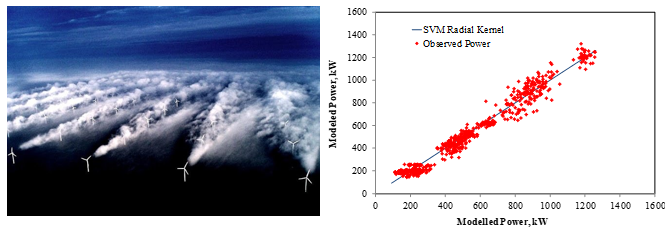
Figure 3: Wake propagation in a wind farm (left) and results of the support vector machine model for the wake losses (right).
Wind being a stochastic phenomenon, the power output from wind energy systems may significantly vary from time to time, in tune with the temporal changes in the strength and direction of available wind resource. These frequent changes in output may pose significant challenges in grid integration of wind farms as well as the efficient dispatch of generated wind power. Hence, reliable forecasts of the power output from the farms, at different time intervals, are essential for the efficient management of wind energy projects.
Keeping in this view, a reliable wind farm power model has been developed employing artificial intelligence techniques. Models based on different machine learning methods are developed and their respective accuracies are estimated. These models can be trained with historic data on power output from a wind farm at a given wind speed, direction and stratification. A representative result, showing the performance of Support Vector Machines in forecasting the power output from an offshore wind farm, is shown in the figure. These models can further be integrated with the Numerical Weather Prediction (NWP) systems to forecast the wind farm output at different time scales.