
This project applies multi-objective evolutionary computation to human activity discovery: teaching an autonomous robot to find and group human activities from observation, without labelled training data. Where most human-activity work focuses on learning and recognition from known categories, this project targets the harder, less-explored discovery stage, letting the activities emerge from the data itself.
Background
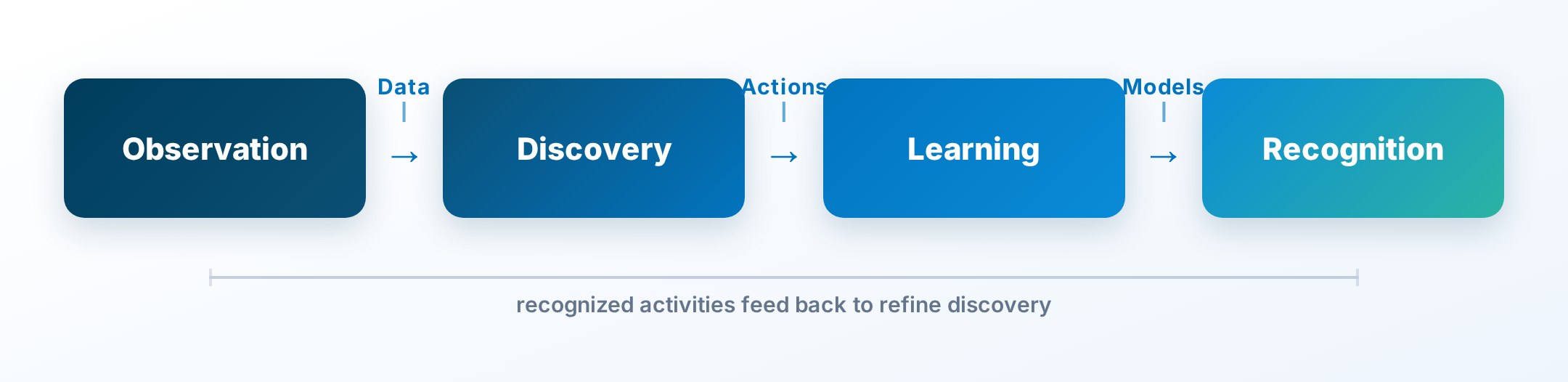
Evolutionary Computation (EC) is a fast-growing area of artificial intelligence, with origins in the 1950s, that has produced human-competitive results on problems from classification and clustering to design optimisation and automatic program generation. While deep learning is widely used for computer-vision tasks such as human activity analysis, far less work has explored evolutionary techniques for these problems. Human activity analysis can be seen as a pipeline, from observing data, to discovering the activities within it, to learning a model for each, to recognising activities. Most effort goes into learning and recognition; this project concentrates on discovery.
Aims and objectives
- Develop multi-objective evolutionary algorithms (MOEA) for human activity discovery: build on existing unsupervised and deep-learning frameworks, test on daily-living activity data, and refine them with MOEA methods.
- Develop an autonomous robot using the algorithms: find an optimal feature set for clustering human actions, let a mobile robot discover actions from its own observations, collect a substantial Activities of Daily Living (ADL) dataset, and evaluate discovery performance on public and in-house datasets.
Research team
- Dr Daphne Teck Ching Lai, UBD (Principal Investigator)
- Dr Ong Wee Hong, UBD (Co-Investigator)
- Parham Hadikhani, UBD (PhD researcher)
- Professor Yuji Sato, Hosei University, Japan (external collaborator)
- Adli Mahari, UBD (Research Assistant)
- Norsyamimi Razak, UBD (Research Assistant)
Publications
- Lai, D. T. C., and Sato, Y. (2021). Hybrid Multiobjective Evolutionary Algorithms for Unsupervised QPSO, BBPSO and Fuzzy clustering. 2021 IEEE Congress on Evolutionary Computation (CEC), 696-703. doi:10.1109/CEC45853.2021.9504968
- Hadikhani, P., Lai, D. T. C., and Ong, W. H. (2023). A Novel Skeleton-Based Human Activity Discovery Using Particle Swarm Optimization With Gaussian Mutation. IEEE Transactions on Human-Machine Systems, 53(3), 538-548. doi:10.1109/THMS.2023.3269047
- Hadikhani, P., Lai, D. T. C., and Ong, W. H. (2024). Human Activity Discovery With Automatic Multi-Objective Particle Swarm Optimization Clustering With Gaussian Mutation and Game Theory. IEEE Transactions on Multimedia, 26, 420-435. doi:10.1109/TMM.2023.3266603
- Hadikhani, P., Lai, D. T. C., and Ong, W. H. (2024). Flexible multi-objective particle swarm optimization clustering with game theory to address human activity discovery fully unsupervised. Image and Vision Computing, 145, 104985. doi:10.1016/j.imavis.2024.104985
- Lai, D. T. C., and Hadikhani, P. (2024). Automatic Evolutionary Clustering for Human Activity Discovery. In Advances in Data Clustering (pp. 59-77). Springer. doi:10.1007/978-981-97-7679-5_4
Project details
Started 1 January 2020, duration 24 months. A previous IADA research project. Related research pages: UBD AI Lab.
Explore more on the Projects page.